
Working with the Right Bilingual Wedding Celebrant in Cartagena de Indias

Merging Two Worlds in One Single Voice
You’re planning a wedding in the fantastic Cartagena, merging two incredible cultures—Colombian and U.S. Canadian, or European families—and two languages. It’s an act of profound love, especially if you live abroad.
All of this time officiating weddings, I’ve learned that my role is not to translate words, but to translate feeling. I actually, when nobody’s watching, call myself “the translator of abstraction,” because there is nothing more abstract than the language of love. To ensure that every shared moment—every laugh, every tradition—flows with genuine fluidity for every single guest, is what I love doing.
This is the non-negotiable value we need when merging worlds. Especially if this bilingual act is happening in my hometown; my responsibility is to make it truly unforgettable for everyone. I am your trusted Wedding Officiant.
To avoid coming across as “too cocky,” I’ll say that for almost a decade, in the world of symbolic, bilingual weddings, I’ve observed a common formula bicultural couples apply, and although functional, it is deadly to the ceremony's magic. Let me explain:
The "Ping-Pong" Problem: Why Divided Voices Don’t Jive My Vibe

What are the disadvantages of hiring a separate wedding officiant and translator?
In my experience crafting bilingual ceremonies and a professional conference interpreter, I have learned that hiring a traditional wedding officiant alongside an external translator or a simultaneous interpreter forces your guests into a dizzying, rhythmic, head-turning game—the "Ping-Pong" effect. Their eyes dart back and forth, losing the moment's emotional weight, which is exactly when they politely pull out their phones to get absorbed by the matrix.
Let me put it this way: bringing corporate wedding translation services to the altar introduces unnecessary operational hurdles and completely disrupts the magic. When you hire a traditional translation agency, they focus on technical accuracy rather than emotional resonance—a clinical approach that freezes the ceremony's momentum.
Beyond the steep logistical costs of sourcing specialized equipment like interpretation booths, there is a human factor to consider: not every professional conference interpreter is built for the altar. Many are extraordinary behind the mic in a booth, but naturally shy and uncomfortable with the public exposure a wedding demands. In my world, performance and emotional availability matter.
Can a bilingual family member officiate a wedding ceremony?
While asking a bilingual relative seems like a warm, cost-effective choice, it is highly risky for both the emotional flow and the social diplomacy of your altar. Granted, some family members are naturally charismatic, but most lack the professional awareness required for a mixed global audience.
When a well-meaning relative takes the mic, they often lack the necessary filter, taking inside-joke liberties that can fall completely flat. I have witnessed those awkward moments firsthand—where half the crowd is left with frozen smiles and hesitant, polite laughter because a joke didn't translate well or wasn't appropriate for the corporate colleagues, international partners, and diverse social circles in attendance.
Above all, a destination wedding is a grand gesture of hospitality. Your guests have already made a massive effort to travel to another country to support you; they are there to celebrate, feel pampered, and fully immerse themselves in the moment. Asking them to translate transitions a joyful guest into an stressed coordinator. Your loved ones deserve to enjoy the experience completely hands-free, without inheriting the heavy logistical responsibility of your altar.
Should you use printed translation scripts for a bilingual wedding?
Breaking the connection with printed scripts: Some couples try to avoid the two-voice distraction by simply handing out printed translation scripts to their international guests. This option is absolutely unnecessary and, frankly, a disaster for the atmosphere of your ceremony. Handing out physical scripts is not only wasteful—those papers invariably end up forgotten or discarded on the chairs—but it actively breaks the sacred emotional connection at the altar.

Imagine going to the movies and being handed a translated paper script to read under a dim light instead of actually watching the masterpiece on the screen! A wedding is a live, shared experience. Your guests shouldn't be obligated to read a text document rather than simply look up, feel the atmosphere, and absorb the emotional core of your ceremony in real time.
I insist, true hospitality means ensuring everyone is comfortable and effortlessly included. Your loved ones made a major effort to travel and support your union; they deserve to be fully immersed as pampered guests, not reading through a translation handout.
My Manifesto: One Voice, Total Dedication
How do I seamlessly manage a bilingual wedding ceremony without losing guest engagement?
To eliminate a fragmented experience, I reject the two-voice setup and bring a truly unique advantage to the altar: 100% exclusive focus on your ceremony. I maintain the artistic ability to seamlessly switch between Master of Ceremony, Wedding Officiant, and Translator—all in one fluid, trusted voice. The real-time delivery is so fluid and natural that guests remain emotionally present and fully immersed in the experience, regardless of the language being spoken.
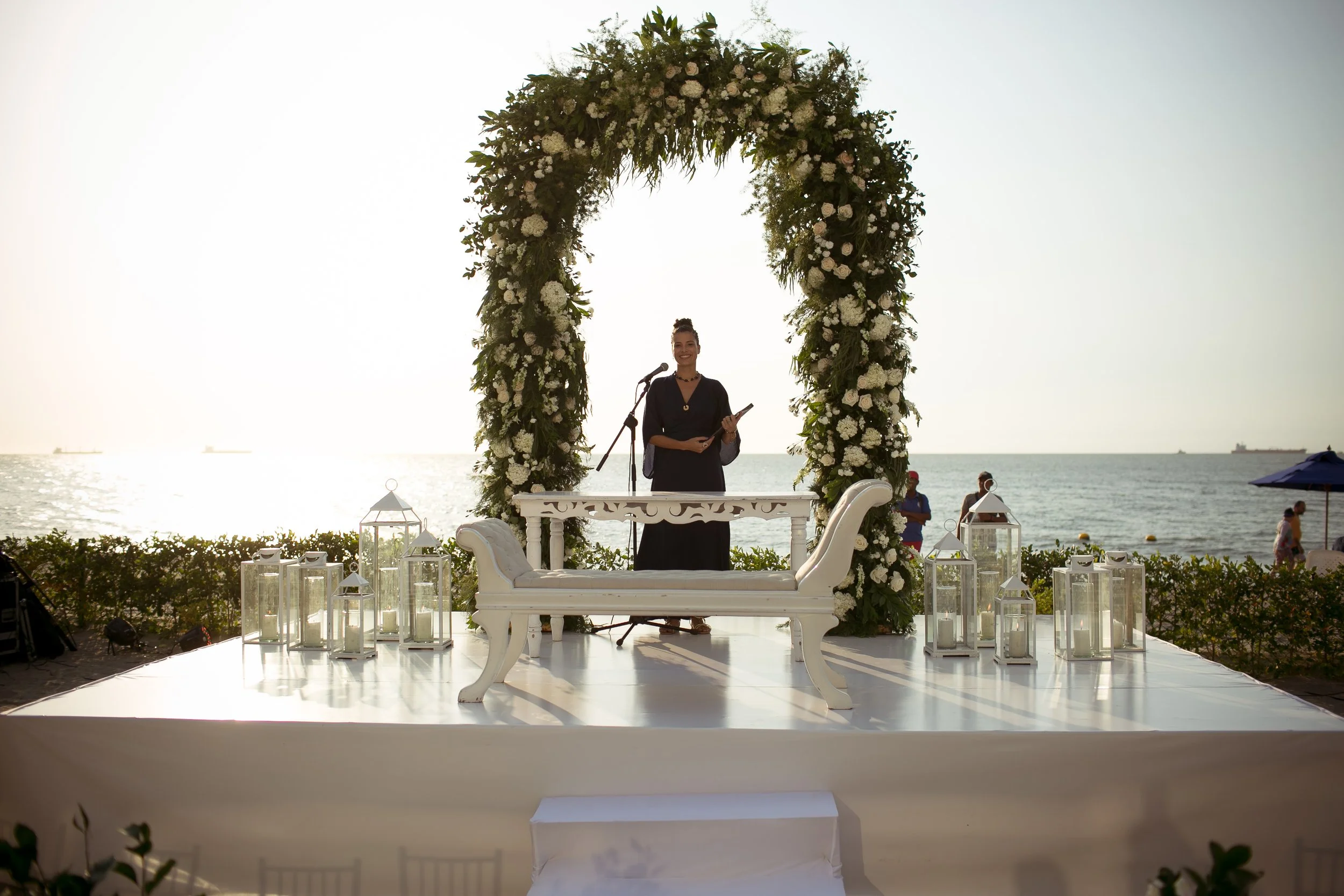
My dedication ensures that your entire ceremony receives the unhurried focus and emotional availability I deserve to give. Not that all weddings made without Bel Altar are wrong or lack emotion; however, if you are aiming for something that resonates with everybody in your wedding, then you are in the right place.
Maybe this is a better way of looking at it: my wedding ceremonies are not iconic because I can translate from English to Spanish; they are amazing because I was blessed with the power of uniting communities in two languages.
How to inspire your global community on your wedding day?
Your guests should not be included in your intimacy, but inspired by the foundation of your love. I help you achieve this by ensuring every word, including the intimate reading of your Love Realities, is delivered and understood with emotional impact—all seamlessly delivered by one Bilingual Wedding Celebrant.
What are the benefits of hiring a single bilingual wedding officiant?
Merging your two worlds: Choosing a single, fluid voice to manage your bilingual ceremony ensures complete emotional continuity, absolute diplomacy for a global audience, and a stress-free experience for your guests. Instead of navigating the fragmented logistics of external translation services or technical booths, a specialized bilingual wedding celebrant guarantees that your love story is felt, understood, and celebrated by everyone in real time.
Ready to explore how my one voice can merge your two worlds? Contact me
